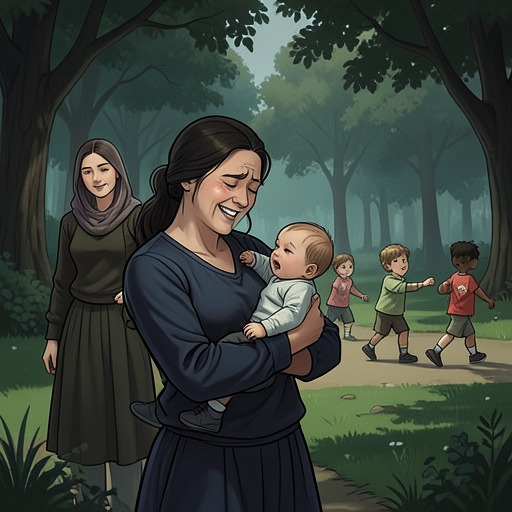
Billy and Mabel post Father’s Day cards to Mark
Bridget Jones: Mad About the BoyBilly Darcy and Mabel Darcy mark Father’s Day by making cards for their dead father, Mark Darcy, and asking Bridget Jones to post them to him. The small domestic ritual gives the children a way to address a father they cannot grow up with, while Bridget meets their grief through photographs, conversation and the act of sending the cards. The post becomes both an ordinary errand and a gesture toward an absent member of the family.
Background and Occasion
Mark Darcy was killed in Darfur when the armoured vehicle in which he was travelling struck a landmine. The account of his death identifies him as a prominent human-rights lawyer whose intervention had helped secure the release of two British aid workers held hostage for seven months. It also records what his public achievements cannot soften: he left behind Bridget, their two-year-old son, William, and their three-month-old daughter, Mabel. The Father’s Day cards arise within this family history of loss, not as a way of undoing it but as a way the children can make their father present in their own terms.
Bridget’s grief is already bound up with the difficulty of parenting without Mark. In a letter written amid photographs and newspaper cuttings, she tells him that she cannot manage alone and misses his comfort, counsel and help with the children. She worries that Billy will not know how to become a man without his father, and that Mabel will not know him at all. Her private anguish gives the children’s later gesture a double weight: the cards express their relationship with Mark, while also confronting the future Bridget fears they must face without him.
The Cards and the Post
On the drive home, Billy raises Father’s Day and tells Bridget that the children have made cards. Mabel confirms that she has made one too. Bridget pulls over, switches off the engine and wipes her face before asking to see them. The pause matters: she stops the moving car and turns her attention fully to what the children have brought her, receiving the cards rather than passing over their significance in the rush of the journey.
Mabel’s picture shows a family with a daddy, a mummy, a little girl and a little boy. Billy’s drawing places a boy playing a game with his father inside a heart and labels it “Daddy”. The pictures are not identical: Mabel draws the family as a group, while Billy frames a shared activity between father and son as an image of affection. Together, they make visible the ordinary family scenes the children wish to connect with Mark.
Mabel asks whether they can post the cards to Daddy. At home, Bridget brings out photographs of the children with Mark. One shows Billy in a small suit matching his father’s, the two standing in the same pose with one hand in a trouser pocket; another shows Mark holding newborn Mabel in her onesie. They talk about Daddy, and Bridget tells them she is sure he knows what they are doing and still loves them. Then they go out and post the cards. Mabel addresses hers “Daddy. Heaven. Space”, giving the delivery an imagined destination that reaches beyond an ordinary address. Bridget’s wry thought that she has traumatized the postman sits alongside, rather than cancelling, the tenderness of the act.
Grief, Memory and Continuing Bonds
The cards do not resolve Bridget’s bereavement or answer the questions she raises about her children growing up without their father. Instead, they provide a concrete family practice for speaking about Mark. The photographs let Billy and Mabel see themselves with him; the conversation gives them words for his place in their lives; posting the cards carries that connection out of the house. The sequence makes remembrance an action shared by mother and children, not solely Bridget’s solitary work of mourning.
The book returns to the same connection through smaller gestures and recurring memories. During an earlier night, Mabel sees the full moon and tells Bridget that it follows her; she also points out an owl. The moon becomes part of the child’s way of making sense of what is near and far, while Bridget’s response belongs to the same intimate world in which children speak to their absent father. At Christmas, the carol brings back a series of earlier celebrations, including the first Christmas Bridget and Mark took Billy to church in a little Santa Claus outfit and the first Nativity play after Mark’s death. Remembering does not replace the lost celebrations: it makes their contrast, and the continuing presence of Mark in family memory, newly felt.
Significance
The Father’s Day episode turns on a modest reversal. A day that might simply mark the father the children no longer have becomes an occasion on which they can address him and enlist Bridget in doing so. The cards cannot reach Mark in a literal sense, but their making and posting gives the children’s attachment a visible form and gives Bridget a role in sustaining it. The imagined address, the family photographs and the shared conversation hold together two truths the episode does not force into a resolution: Mark is dead, and he remains part of the family’s everyday emotional life.